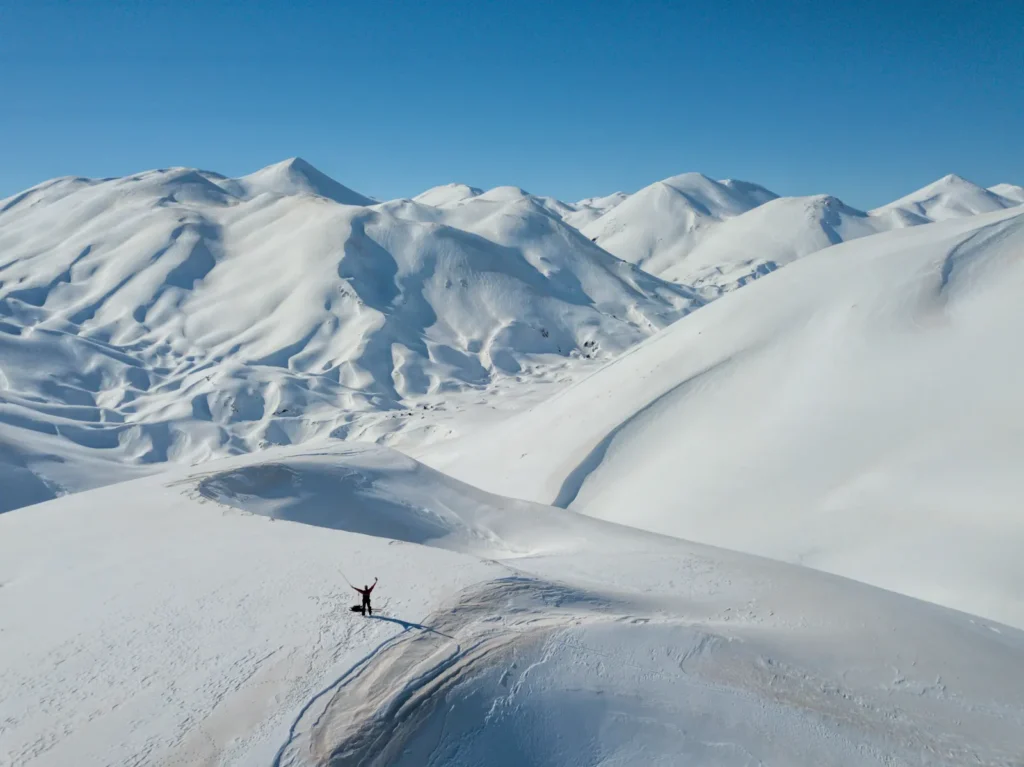
Something magical happens on this island. There are many times when the Alps have no snow at all, while down in the southern Mediterranean, very close to Africa, this tiny island is buried in snow! But how is this possible?
Crete has three major mountain ranges, all rising above 2,000 meters, and they act like a massive wall between the Aegean Sea, the Adriatic Sea, and the Libyan Sea.
What happens when an island with such high mountains is surrounded by so many seas?
Quite simply, the chances of snowfall increase dramatically. Three different weather fronts from three different directions can affect the island. Most of the time, the cold air coming from Eastern Europe and he Black Sea brings low temperatures and light precipitation. But when it combines with a low-pressure system from the west carrying moisture-rich clouds, the result can be explosive.
Equally strong snowfall occurs when low-pressure systems originate from the Gulf of Sirti and combine with cold air masses from the Balkans. In all cases, the cold clouds absorb moisture during their long journey over the seas, and when they reach the cold mountainous terrain of Crete, they are blocked. Almost trapped against the mountains, they release a large amount of this accumulated moisture, which turns into snow because of the low temperatures.
So is the snow… made of seawater?
No, it’s not salty — but it does contain a high amount of moisture. This is also why Crete almost never experiences avalanches. Wet snow bonds very easily with existing or newly fallen layers. As a result, layer separation — the most common cause of avalanches — rarely occurs on the island. The snow layers bond immediately, and avalanches are extremely rare, appearing only after very intense and prolonged snowfall.
Why does it melt so slowly?
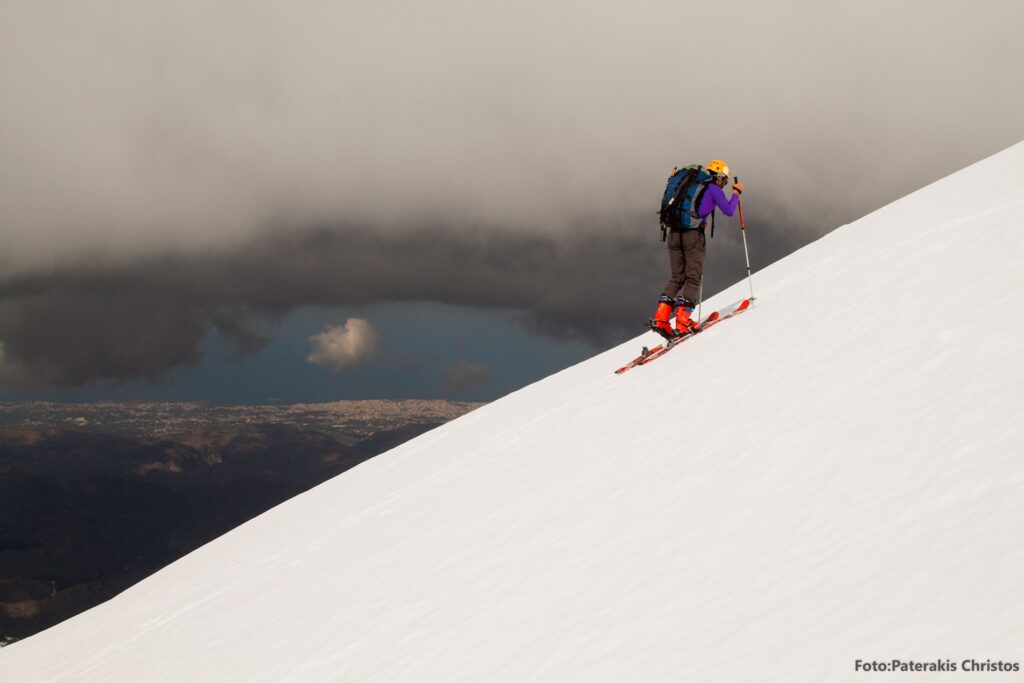
The terrain of Crete’s mountains — with many plateaus and numerous peaks — often creates microclimates with extremely low nighttime temperatures. The north-facing slopes receive only a few hours of sunlight. Another phenomenon increases the lifespan of the snow: nighttime temperature inversion. On a sunny day a small amount of snow may melt, but once the sun sets, the clear sky causes a dramatic temperature drop and strong frost forms. A thick layer of ice develops on the snow’s surface, protecting it from melting.
In early spring, when the sky is clear almost every night, the snow remains almost untouched on the northern slopes. Even with strong sunshine throughout the day, only a small amount melts — and much of that water refreezes overnight. some years, you can ski a huge descent on the northern side of Mount Psiloritis even in May, as the orientation of the north slopes preserves the snow very late into spring.